
What Is Direct-Push Technology (DPT)?
By John Fontana, CPG, CWD
This is the first in a series of articles I plan to publish here regarding starting with a brief history and present capabilities, advantages and limitations, of Direct-Push Technologies (DPT). Future articles will expand on how this environmentally focused drilling method then to significant advances in direct-sensing technologies (or High-Resolution Site Characterization, HRSC), and In-Situ Injection Remediation technologies. Combined, these, more sustainable technologies have significantly improved how the majority sites are characterized and remediated by reducing investigation derived waste (IDW), and improving the resolution of the conceptual site model (CSM) so that remediation designs are more likely to work the first time.
What Is Direct-Push Technology?
Direct-Push Technology (DPT) has become one of the most important tools in modern environmental site investigation and remediation. Developed specifically for environmental applications, DPT provides a faster, more efficient, and often less expensive alternative to conventional drilling methods for collecting soil, groundwater, and soil gas data in unconsolidated sediments.
Direct-Push Technology refers to two types of drilling systems:
- Static Push
- Percussion Push
Static push existed in the form of large (20 to 40 ton) Cone Penetrometer Testing (CPT) rigs, which use the static weight of the push vehicle to drive the rods in the ground with hydraulic rams, and was developed for making measuring geotechnical parameters such as tip-resistance and sleeve friction. Today, these can also incorporate some of the sensing tools that were designed for the percussion rigs.

Percussion push rigs are a more recent innovation, such as those manufactured by companies like Geoprobe Systems, and are designed and primarily used for environmental site drilling, and some geotechnical applications. These rigs do not need as much static weight, although that is one component of the “push” power, but rather use a high frequency percussion hammer to drive sampling tools into the ground. Both systems are limited to unconsolidated sediments or extremely weathered bedrock, and also cannot be driven in cobbly or bouldery soils.
The technology emerged in the late 1980s and early 1990s as environmental professionals sought better ways to characterize contamination without the cost, waste generation, and logistical challenges associated with traditional hollow-stem auger and rotary drilling methods. Over the past three decades, DPT has evolved from a simple sampling platform into a highly sophisticated system capable of collecting high quality and high resolution continuous environmental data, supporting advanced site characterization, and implementing in-situ remediation injection technologies.

The Evolution of Direct Push Technology
The earliest applications of DPT focused on environmental sampling. Specialized hydraulic percussion rigs were designed to advance small-diameter tools into the subsurface without generating drill cuttings. This approach enabled rapid collection of soil samples, groundwater samples, and soil gas data while minimizing investigation-derived waste and reducing site disturbance. Early rigs were small, light, and had limited depth range, but both the rigs and tooling today are much more robust and capable of greater depth and more sampling methods. Many of these DPT rigs are also equipped with auger heads capable of drilling through DPT refusal, or installing larger annulus holes for monitor wells. The number, size, and variety of sampling tools has also expanded significantly. Dual-Tube probe rod diameters range from 2.25″ up to 4.5″.
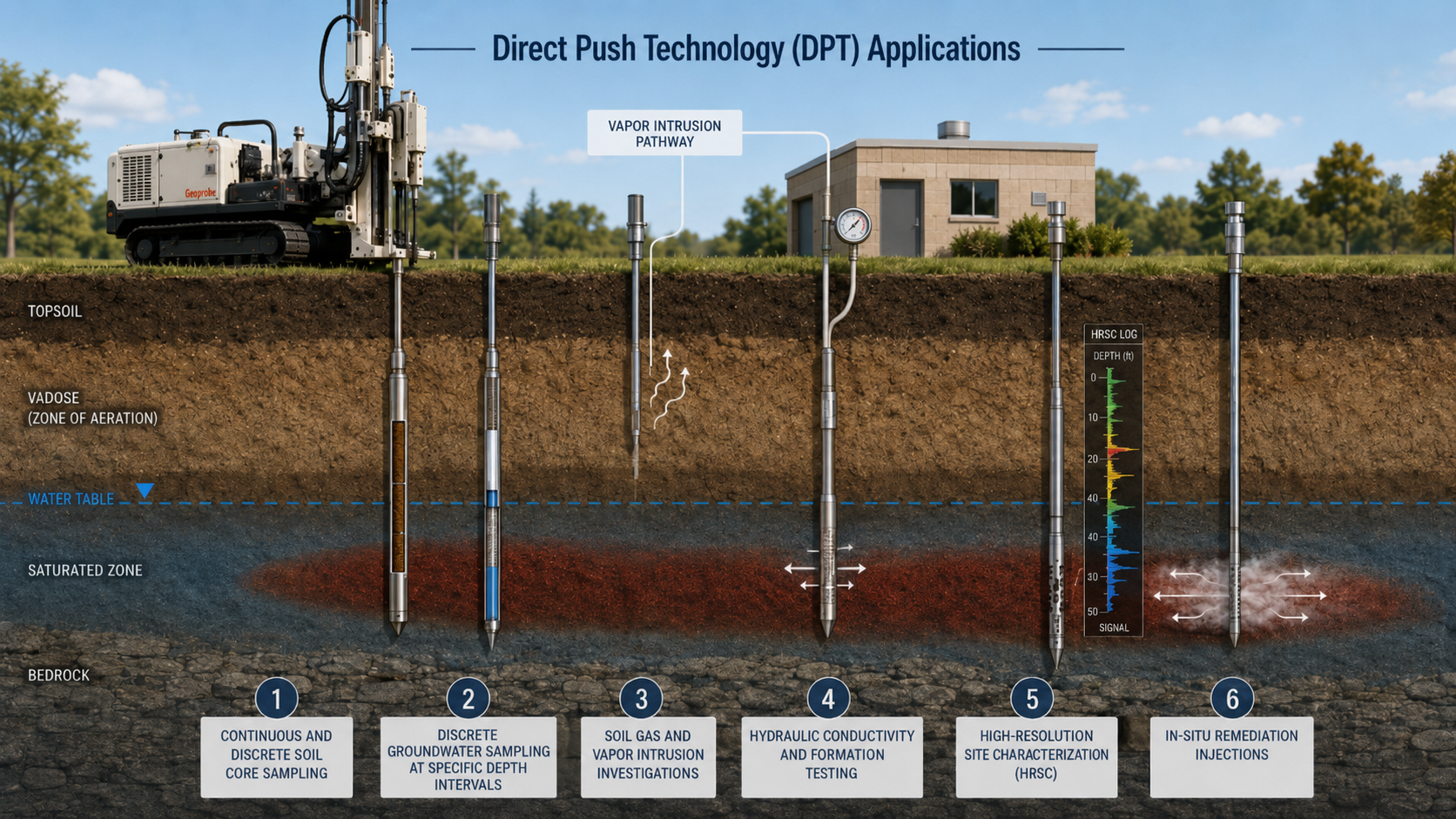
As the technology has matured, and rig power has grown, new tools are available now to improve both data quality and efficiency of investigations and remediation programs. Today, DPT systems support:
- Dual-Tube (cased hole) continuous and discrete soil core sampling
- Installation of small and standard size monitor wells
- Discrete groundwater sampling at specific depth intervals
- Soil gas and vapor intrusion investigations and monitoring
- Hydraulic conductivity and formation testing, including slug testing
- High-resolution site characterization (HRSC)
- In-situ remediation injections
- Geotechnical data acquisition (SPT testing through DPT rod)

Improving Data Quality Through Better Sampling
One of the most significant advancements in DPT has been the development of Dual-Tube coring systems. Unlike conventional drilling methods that may disturb or mix soils during drilling, dual-tube systems allow collection of relatively undisturbed continuous cores while the outer casing stabilizes the borehole and prevents cross-contamination that is typical of open hole coring systems.
These systems provide:
- Continuous lithologic information
- Improved identification of thin contaminant zones
- Better understanding of site geology and hydrogeology
- Reduced cross-contamination between intervals
For groundwater investigations, discrete interval groundwater sampling tools allow environmental professionals to collect samples from specific depths without installing a monitoring well. This approach often provides higher-resolution vertical data, helping identify contaminant distributions that may otherwise be missed using conventional well-screened intervals.
Similarly, specialized soil gas sampling tools have transformed vapor intrusion and vadose zone investigations by allowing rapid collection of soil gas samples at targeted depths. These data can help define contaminant migration pathways and identify potential risks to buildings and occupants.
Supporting High-Resolution Site Characterization
As environmental professionals recognized the value of collecting more detailed subsurface data, DPT became the platform of choice for High-Resolution Site Characterization (HRSC).
Advanced direct sensing tools such as Membrane Interface Probe (MIP), Optical Image Profiler (OIP), Hydraulic Profiling Tool (HPT), Electrical Conductivity (EC), and Laser-Induced Fluorescence (LIF) sensors can now be deployed through DPT platforms to generate continuous subsurface datasets in real time. This tools have become significantly more robust in recent year to withstand the beating of the 7000 Series Geoprobe percussion hammers, but cannot be driven by the newest and larger series hammers without risking tool damage.
These technologies help create more accurate conceptual site models, improve remediation design, and reduce uncertainty in site decision-making.

Expanding into In-Situ Remediation
Today, DPT is used not only to characterize contamination but also to treat it. Specialized injection tooling allows practitioners to deliver remedial amendments directly into targeted treatment zones. Applications include enhanced bioremediation, chemical oxidation, chemical reduction, adsorbent amendments, and emerging treatment technologies.
By combining characterization and treatment capabilities on a single platform, DPT has become a cornerstone technology for modern environmental remediation projects.

Looking Ahead
Direct Push Technology continues to evolve as new sensors, characterization methods, and remediation approaches are developed. What began as a faster way to collect environmental samples has become an integrated platform for site investigation, conceptual site model development, and in-situ treatment implementation.
In future articles, we will take a deeper dive into High-Resolution Site Characterization (HRSC) tools, soil gas applications, and the growing role of DPT in modern In-Situ Injection Remedial programs.